Friday, January 7, 2011

Women of the Word, Jan. 6, 2011 and Dec. 16, 2010


Reviewing Genesis and its importance as the first book of the Bible, we know that Abram and Sarah were not only husband and wife but also brother and half-sister. In ancient times, it was very critical that the clan/tribe be kept intack and continued through the generations. Genesis is a mature volume of theology more than a history book. It was written by gathering ancestoral sources stories during the Babylonian captivity in the sixth century B.C. This book is an attempt to explain WHY the Jews were different.

God made the world good but "we got out of relationship" with God in the Garden of Eden; then Caine and Abel got out of relationship; then in the Noah story, Noah walked with God but no words of his were ever recorded in the Bible.
God then changes...There occurs the Scandal of Particularity when God will build his kingdom beginning with Abraham and everyone else will want to emulate Abraham. God chose a central "chosen people" who would grow spiritually to fulfill His purpose.
Genesis is therefore the story of a people's (the Israelites) encounter with God.

The Word is the means by which God makes himself known, declares His will and brings about His purposes. The word then became flesh in the New Testament (Jesus) and He dwelt among us.
God lives outside of time and space. Jesus was born and lived inside of time and space.
In the time of the early Babylonian captivity, God picked Abraham and made a promise to him. Abraham believed the promise.
As we read forward in Genesis, we learn that Abraham will go to astonishing ends to make sure His promise is fulfilled!
At the conclusion of class, Barbara passed around a book with a photograph of the burial site of Sarah in the Cave of Macahpehal of Hebron.

Next week's lecture: Chapter 24 in Genesis (Isaac and Rebekah).
Submitted by Vicky Steinwender

Dec. 16, 2010
Genesis 22 and 23
The Women of the Word are learning about the historical evolution of Christianity as told through the collection of ancient memories in the Bible. We are also learning aspects of those stories which we did not learn in Sunday school, some are startling, some are amusing and some are comforting. Each chapter sparks our own memories, some heart-wrenching, some reflective, but all allow us to share ourselves with each other in unique ways as we relate to the readings and understanding of the verses of Genesis. As we women learn together, laugh and cry together, we are creating our own memories and verses.

In Genesis 22, Abraham was commanded to sacrifice his beloved son Isaac on Mount Moriah in order to prove that he loved God more than his son. God, in his mercy, stopped the sacrifice and Isaac survived. His plan, that Abraham develop character after Abraham’s much less-than-moral behaviors, was successful. We also learned about the genealogy of clans and tribes, familial connections (with such names as Uz and Buz) which would be so important in forming alliances and land acquisitions. Those areas of importance were then carried over to the first Biblical mention of mourning, dealing with, and burying of the dead.

In Genesis 23 we learn of Sarah’s death at age 127, which is the creative assessment of a very long time by ancient memory story tellers. Not wanting to leave her body just anywhere (which is ironic since Abraham hid Sarah’s true relationship as his wife and offered her as chattel three times in order to save his own skin), Abraham, paid an outrageous (approximately 2100 BC at the time) sum of 400 shekels of silver (worth .5 ounce or 14.17 grams in whatever amount is stated in today’s silver market) to land owner Ephron for Sarah’s burial cave. Abraham finally showed Sarah the reverence and love she deserved. The Cave of Machpelah acquisition established land title, including every tree, for Abraham and his descendants which resulted in the establishment of a permanent family estate.

These two chapters of Genesis fostered discussions concerning man’s obedience to God, the centering of family connections, the establishment of possibly the first familial burial ground (which included the subject of St.Thomas' Columbarium), and Abraham’s final respect for Sarah.
We concluded our study with a prayer which Miriam Williams had shared with us a few months ago.
Submitted by Jill McGrath

Thursday, January 6, 2011

From the men's bible study, Jan. 5

Isaiah 42:1-9

{1] Here is my servant, whom I uphold, my chosen, in whom my soul delights; I have put my spirit upon him; he will bring forth justice to the nations. {2} He will not cry or lift up his voice, or make it heard in the street; {3} a bruised reed he will not break, and a dimly burning wick he will not quench; he will faithfully bring forth justice. {4} He will not grow faint or be crushed until he has established justice in the earth; and the coastlands wait for his teaching. {5} Thus says God, the LORD, who created the heavens and stretched them out, who spread out the earth and what comes from it, who gives breath to the people upon it and spirit to those who walk in it: {6} I am the LORD, I have called you in righteousness, I have taken you by the hand and kept you; I have given you as a covenant to the people, a light to the nations, {7} to open the eyes that are blind, to bring out the prisoners from the dungeon, from the prison those who sit in darkness. {8} I am the LORD, that is my name; my glory I give to no other, nor my praise to idols. {9} See, the former things have come to pass, and new things I now declare; before they spring forth, I tell you of them.

Acts 10:34-43
{34} Then Peter began to speak to them: "I truly understand that God shows no partiality, {35} but in every nation anyone who fears him and does what is right is acceptable to him. {36} You know the message he sent to the people of Israel, preaching peace by Jesus Christ—he is Lord of all. {37} That message spread throughout Judea, beginning in Galilee after the baptism that John announced: {38} how God anointed Jesus of Nazareth with the Holy Spirit and with power; how he went about doing good and healing all who were oppressed by the devil, for God was with him. {39} We are witnesses to all that he did both in Judea and in Jerusalem. They put him to death by hanging him on a tree; {40} but God raised him on the third day and allowed him to appear, {41} not to all the people but to us who were chosen by God as witnesses, and who ate and drank with him after he rose from the dead. {42} He commanded us to preach to the people and to testify that he is the one ordained by God as judge of the living and the dead. {43} All the prophets testify about him that everyone who believes in him receives forgiveness of sins through his name."

Matthew 3:13-17
{13} Then Jesus came from Galilee to John at the Jordan, to be baptized by him. {14} John would have prevented him, saying, "I need to be baptized by you, and do you come to me?" {15} But Jesus answered him, "Let it be so now; for it is proper for us in this way to fulfill all righteousness." Then he consented. {16} And when Jesus had been baptized, just as he came up from the water, suddenly the heavens were opened to him and he saw the Spirit of God descending like a dove and alighting on him. {17} And a voice from heaven said, "This is my Son, the Beloved, with whom I am well pleased."

Analysis and Reflection
The contrast between the old and the new is a consistent feature of the New Testament. Everything before Jesus is "old;" he came the usher in the "new." This is expressed both by what Yahweh does—law in the past, love now—as well as how he does it—sending prophets in the past, the Son in the present. The notion is picked up in the Gospel; in the past Jesus would have baptized John, but now John, "to fulfill all righteousness" baptizes Jesus.

The Gospel reflects the celebration of Jesus’ baptism. The other lessons extend the point made by the Gospel, that Jesus is God’s Son. As God’s Son and therefore without need for repentance, he has identified himself with the needs of his sinful people by participating in John’s baptism for the forgiveness of sins. He has further identified himself with all who believe in him, even a Roman Centurion, who must as a part of his military service, honor gods and engage in acts that were repugnant to the God of Israel.

If we see ourselves as Gentiles, then we will know that God’s love and mercy is ours only by his gift, not by our deserving. If we think of ourselves as God’s chosen people today, then, too, we are God’s because he chose us. In either case, our lives will reflect who we are and whose we are.
Submitted by Dick Nelson

Monday, January 3, 2011

Yoga pose of the month

Mountain Pose/Tadasana

Benefits:

Improves posture.
Strengthens thighs, knees and ankles.
Firms abdomen and buttocks.
Reduces flat feet.
Gives one a sense of balance and poise.
Thank you for sharing this journey with me.
Our next classes are
Monday, 1/3, 6:30 pm, in the Parish Hall at St. Thomas Episcopal Church
Submitted by Teri Plumridge

Sunday, January 2, 2011

Altar Flowers December 2010

Christmas Flowers
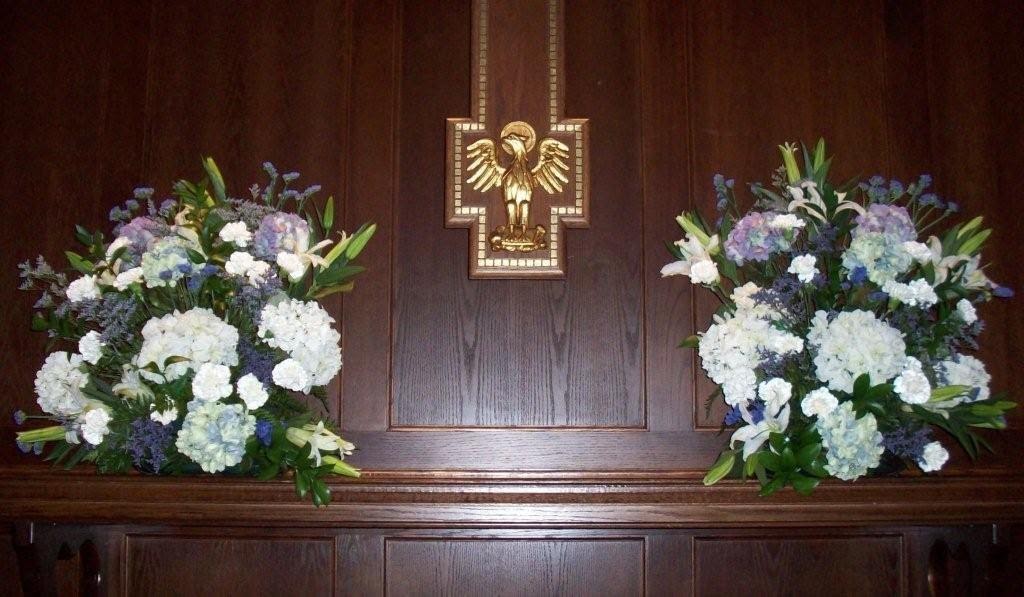
Thank you to the flower guild for the magnificent flower arrangements!


December 19
The Altar Flowers are given to the Glory of God and in thanksgiving for the 40th anniversary of Dr. Haig and Louise Yardumian.


Flower designers: Louise Yardumian and Julie Songster


December12
The Altar Flowers are given to the Glory of God and in loving memory of John and Eleanor Clark and Angela Clark by Rene Clark and Richard Davis.


Flower Arrangers: Pam Holley and Caron Burgess.


December 5
The Altar Flowers are given to the Glory of God and in thanksgiving for the birthday of Michael Rees by Martha Baker and In Memory of Robert M. Ellinwood by Gloria Ellinwood.

Flower designers: Elizabeth P. Walters-Alison and Vicky Steinwender.

Wednesday, December 29, 2010

From the men's bible study, Dec. 29


Jeremiah 31: 7-14; Ephesians 1: 3-6, 15-19a; Matthew 2: 13-15, 19-23


Jeremiah was a Prophet (not an amphibian), he lived in Anathoth, two miles east of Jerusalem and was of a well-to-do family. He was called to be a prophet around 626 BC and suffered during the reign of five weak, and ineffective Judean kings. He carried on his prophetic office during the Babylonian Exile, although he remained in Judea, he was an exile none the less being away from the refuge community. He dealt with many problems and wasted no time in taking action to condemn idol worship. This passage (chapter 31) was written in the time King Zedekiah was on the throne. It is referred to as Jeremiah’s 17th prophecy; one of Hope and Comfort for the exiles. He promises the exiles that Judah and Ephraim will be restored, and they will enjoy a safe journey back to Israel from Babylon. The words evoke an image of a perfect land with prosperity, food, watered gardens, and celebrations with song and dance. My favorite phrase is near the end, “I will give the priests their fill of fatness, and my people shall be satisfied with my bounty, says the LORD.” Even a lonely exile can find hope and encouragement here.

Our Gospel follows the Christmas story from Matthew’s point of view with the typical ties to the Old Testament. The reading is disconnected; it leaves out the verses that cover King Herod’s brutal slaying of the infants. The theme includes heavenly intervention (by an angel speaking to Joseph to leave the county and later to return). The exiled holy family goes to Egypt (a place where the Jewish people have strong memories and history). As Matthew says repeatedly, “so that what had been spoken through the prophets might be fulfilled.” We are in the dark on how long the family remained in Egypt or what they did. We know that there were moderate populations of exiled Jewish people living in Egypt at that time, especially in Alexandria. The Herodian politics led Joseph not back to Bethlehem, but to Nazareth where they settled down. One of Matthew’s connects to the OT is from Hosea 11:1: “Out of Egypt I have called my son.”

Exiles and refugees are very common in our place and time. We see and hear of religious people being persecuted and murdered for their faith; they must move and try to find a safe place. How do we confront outrageous acts of violence and help the exiles?

Reference material includes but not limited to:
J.R. Dummelow: One Volume Bible Commentary
William Barclay: The Gospel of Matthew, Vol. 1
Discussion in this morning’s forum

Submitted by Walt Jaap

Friday, December 24, 2010

Merry Christmas and God's Blessings on all!


                                                         Photo by Diana Leavengood


For there is born to you this day in the city of David a Saviour, who is Christ the Lord. And this will be the sign to you: You will find a Babe wrapped in swaddling cloths, lying in a manger. And suddenly there was with the angel a multitude of the heavenly host praising God and saying: "Glory to God in the highest, and on earth peace, goodwill toward men!" ~ Luke 2:11-14

Wednesday, December 22, 2010

From the men's bible study


                                                     Photo by Diana Leavengood

Isaiah 61:10-62:3
According to the historical-critical consensus, this portion of the book was written by disciples of Second Isaiah (chapters 40-55) after the return from exile. However, the return was not as glorious as Second Isaiah had envisioned (cf. 62:4). Therefore, Third Isaiah continues to articulate the hope of a full restoration of the people and nation, with special attention on setting things right for Jerusalem (cf. 62:1).
In a real sense, when we read Isa 61:10-62:3 during the Christmas season, we are still "looking for the redemption of Jerusalem" and the setting of things right for the nations. Even after Jesus' birth, life, death, and resurrection, we are called to live with hope, entrusting ourselves, our futures, and the future of the world to God and God's deliverance.
Thus, we live as the postexilic community lived, and as the final form of the book of Isaiah invites God's people in every generation to live. We live, entrusting ourselves to God, living in hope toward a future which is claimed and will be redeemed by God, and contributing by our words and deeds toward making the world right and life-serving, for God's sake, for our own sake, and for the sake of "all the nations".

Galatians 3:23-25; 4:4-7

In the previous chapter, Paul, preaching to those Galatian believers and explained that those "under the law" (that is, everyone) cannot receive the divine inheritance through obedience to the law. Instead, the law is like a task master or disciplinarian. Then Paul begins to announce the promise. Now, that faith has come, we are no longer slaves serving a tough taskmaster (the law). Instead, we are God's children through faith in Christ Jesus.
In chapter four, Paul is simply underscoring his main point. Christ has come in the flesh (born of a woman!) to free us from that old master (the law), making possible our adoption as members of God's household—with all the benefits that go with it. It is no longer our relationship to the taskmaster (the law) that determines our situation in the divine household. Instead, it is our relationship to Christ that determines our new status in the family. Consequently, as adopted sons and daughters, we do what children do (call their father Abba—"Daddy" for instance) and receive what children receive: blessing and inheritance.
Paul's overriding concern in the Galatians letter is the distinction between one's relationship to God through faith in Christ as opposed to one's relationship to God via the legal code.


John 1:1-18

The Prologue of John's Gospel is described as one of the finest pieces of literature in all of the New Testament. It introduces the reader/hearer to Jesus as fully human and fully God. Jesus, the Word, is presented as a character from another realm: the logos was in the beginning and then became flesh. The logos was with God and then lived among us. There is something unique about this character. There is in this text another unique character, another one who is sent. His name is John, and he is sent by God. When one is sent by God, there is the indication of a purpose.

The Gospel writer clearly states John's mission immediately upon introducing him: John "came as a witness to testify to the light" (verse 7). John's Prologue ends by saying that no one has ever seen God, that the Son is the only one close to God, and that the Son has made God known. This begs a further question: Who makes the Son known? How do we remember the Son?

Submitted By Dick Nelson