Submitted by Barbara Suhar
Thursday, March 24, 2011
A Banner Day
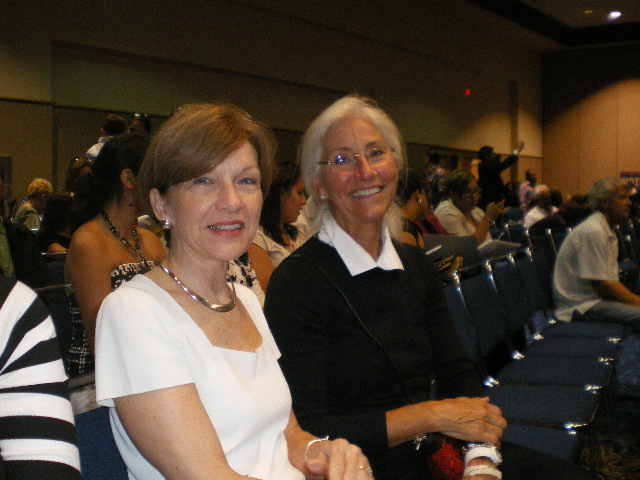
March 23 was a banner day for the Schuller family. Bettina Schuller became an American citizen at the naturalization ceremony held in the Tampa Convention Center. What a blessing for America and for St. Thomas! Bill Futch had a little surprise waiting for her when she returned home.
Submitted by Barbara Suhar


Submitted by Barbara Suhar
Tuesday, March 22, 2011
Choral Festival
Accolades and Thanks to the Saint Thomas Choir and Music Director for the wonderful performance of Nunc Dimittis at the Choral Festival, American Guild of Organists, at First Presbyterian on Sunday. They did it well. The group also participated with the combined choirs from many local churches in Requiem in D minor by Gabriel Fauré. Bob Green sang a very nice solo in the Requiem. A free will offering was given to the families of Sergeant Thomas Baitinger, Officer Jeffrey Yaslowwitz, and Officer David Crawford. All of the musicians performed very well; the Requiem and several other pieces were sung in Latin (complex and challenging). Many thanks to Louise and the choir for the hours of practice and the stunning performance!
Submitted by Walt Jaap
Monday, March 21, 2011
Women of the Word, March 17
Genesis 42-45:4
Main Theme: Joseph meets his brothers as they travel to Egypt where he has been living for quite awhile. (They fail to recognize him when they see him!)
This part of Genesis is about sibling rivalry which all of us have or will experience in our own lives. In Ch. 42, vs. 6, Joseph’s brothers come to Egypt to buy grain and they bowed down to Joseph not knowing he is their long lost brother that they had put into a pit. Pharaoh found him and took him in as a slave in his home and made him very important.
Joseph must have been feeling the scars of how he had been treated by his brothers. We are reminded that when Christ arose from the dead after three days, he still had holes in his hands. Pain is still out there and scars do not go away easily.
Later in the passage, we learn that Jacob is still playing favorites with his sons. Benjamin is one of his most favored sons along with Joseph and Simeon.
In chapter 43, we learn Judah will become the leader to the other brothers. During a later second trip to Egypt, we will see the theme, “I am my brother’s keeper.” This is a 180 degree shift in brotherly relationships. The term, keeping Kosher, also refers to the Jews’ maintaining their identity.
As we read on we see in Chapter 45, that the emphasis is going to be on “keeping in community” with one’s own people.
Submitted by Vicky Steinwender
Friday, March 18, 2011
Lenten study "Nooma", Sunday, March 20 at 9am in the Guild room
NOOMA is a series of short films (10-14 min) that explore our world from a perspective of Jesus. Jesus lived with the awareness that God is doing something, right here, right now, and anybody can be a part of it. Wherever he went, whatever he did, Jesus started discussions about what matters most, because for Jesus, God is always inviting us to open our eyes and join in.
During lent we will meet Sundays from 9:00-9:45am in the Guild room at St. Thomas to watch videos from the series "Nooma" and have small group discussions. We will form groups that will stay together for the six weeks so that we can get to know each other and bond in our spiritual journeys. We will also have an open group for people who won’t be able to come but once or twice.
About the video "Rain":
Things don’t always work out the way we want them to, or the way we think they will. Sometimes we don’t even see it coming. We get hit with some form of pain out of nowhere leaving us feeling desperate and helpless. That’s the way life is. Still, it makes us wonder how God can let these things happen to us. How God can just stand by and watch us suffer. Where is God when it really hurts? Maybe God is actually closer to us than we think. Maybe it’s when we’re in these situations, where everything seems to be falling apart, that God gets an opportunity to remind us of how much he really loves us.
For email subscribers click on http://comeseestthomas.blogspot.com/
to see the two minute preview of "Rain".
Thursday, March 17, 2011
From the men's bible study, March 16
Genesis 12: 1-4a
Last week we were in the Garden of Eden with Adam, Eve, and a serpent. The themes were disobedience, temptation, and a fall from the relationship with God. We have jumped to chapter 12 in Genesis, and passed over a lot of interesting biblical events. In this lesson we are struck with the faithful obedience of another OT giant, Abram (Abraham), the name is translated as “Exalted Father, or father of the multitude” (Father of many Nations). Abram lived a long life; he was born in Ur, Mesopotamia. His life and heritage is in four distinct journeys: (1) the calling, (2) promise of a lineal heir & concluding a covenant, (3) establishing a covenant, changing his name to Abraham, and (4) the great trial. In today’s brief passage from the calling, God tells Abram to leave your father (a tribe or clan of nomadic herders) in Haran and go to a land that God will lead Abram, Sarai (Abram’s wife), and Lot (nephew) to. Considering the time, a family-tribe was the social-political unit, the success and well-being of the person was tied to the clan. To leave the clan, head off into the unknown, based on a calling from God, surely was a challenge. Today, the Jews, Muslims, and the Christians look at Abraham as a great spiritual ancestor of these three monotheistic religions. What does God communicate to Abram to motivate him to take this Journey?
Blessings and Curses; "To be blessed" means 'to be favored by God'. Blessings are directly associated with God and come from God. Therefore to express a blessing, is like bestowing a wish on someone that they will experience the favor of God. A curse is the opposite of a blessing. The blessings that God bestows on Abram are considered to be a covenant. God tells Abram that he will bless those that bless Abram; in you all the families of the earth shall be blessed. Abram will be made a great man, he will found a great nation, and Abram will be a blessing. These words and very big concepts are sufficient to motivate Abram to leave his clan and follow God. Obviously, it was a good decision. To be a blessing is a worthy goal.
Romans 4: 1-5, 13-17
Paul, in this passage presents an argument that deals with Abraham and his worthiness. Paul reports that Abraham did nothing to earn his relationship. God provided for Abraham, there were no laws, edicts, or works in the covenant that Abraham and God entered into. It was a covenant, based on faithfulness of Abraham to follow where God led him. Paul was railing agnist people who said that the route to a relationship with God was based on multiple laws, Paul told them, ditch the laws, it is all about grace.
John: 3: 1-17
It appears in the Lenten season, our Gospel readings are much longer and filled with tons of information. This lesson is a good example. It contains the material about rebirth and 3:16- “For God so Loved the world that he gave his only son so that everyone who believes in him may not parish, but may have eternal life.” One of the most quoted NT verses.
The passage starts with dialog between Jesus and a very scholarly Pharisee and temple leader of the archon- Sanhedrin (the high court of the Jews); his name was Nicodemus. As a Pharisee, Nicodemus was bound by oath to follow each and every law found in Talmud- the complexity of this includes 150 pages governing righteous behavior during the Sabbath. Mr. Nicodemus was well versed in Jewish law; perhaps it was all this law and ritual that drove him to interview Jesus. He visited Jesus at night- was he afraid his peers would see him and he would be condemned? A lot of people are somewhat reluctant to be seen openly with Jesus.
Nicodemus says he knows that Jesus is a teacher from God because of the multiple miracles Jesus has been credited with. Jesus perceives that Nicodemus truly is after the way to enter the Kingdom of God. He tells him several times that it has to do with Anothen- a Greek word of special meaning, difficult to translate into English. It can mean three different things in Greek (the language of John’s Gospel): 1: Completely radically, 2: Again 3: From above. Born anew is a fairly good translation. A more comprehensive thought is to undergo such a radical change that it is to have something happen to the soul which is like being born anew. Nicodemus is very befuddled about this. He thinks about going back to the womb. Rebirth was a component of Jewish traditions, it was part of the ritual of a man that came from a different religion (proselyte) and became a Jew (new birth out of heathenism). Another point about being born anew, the fascination of a Pharisee with keeping the Law as the way to the Kingdom is thrown away. The way into the Kingdom is not complicated by hundreds of laws and definitions, the keys to the Kingdom are Love of God and obedience to the will of God. This takes us back to Abraham and his response to God’s will.
We have a serpent here, Jesus talks about the lifting up of a metal serpent? What is this about? See Numbers 21:9- “So Moses made a bronze snake and put it up on a pole. Then when anyone was bitten by a snake and looked at the bronze snake, he lived.” During the Exodus, God was protecting the tribes in the wilderness from snake bites by a bronze serpent on a pole. John links Jesus to this OT miracle. But more than survival of snake poison, the person that looks to Jesus lifted up can find eternal life.
Nicodemus goes away, but he will be back with us later.
Much credit to:
John Suhar explanations,
J.R. Dummelow’s and William Barkley’s commentaries.
Submitted by Walt Jaab
Tuesday, March 15, 2011
Women of the Word, March 10
Genesis: 39, 40, 41
Despite the opening of the heavens and the resulting parking lot pond, most of us were in our places for this morning's microscopic look at the continuing chapters of Genesis where ancient memories were originally written in continual text on the scrolls, no chapters nor verses. The story scribes were sometimes one voice, other times many voices intermingled. The scriveners just kept on going, babblers on paper.
Barbara taught us that the Age of Patriarchs (Abraham, Isaac and Jacob) was biblically no longer the ultimate power and what became important during these ancient times was community and plurality; society was no longer a party of only men. (Unfortunately, there have been more patriarchal societies since then.) These chapters were written to illustrate the beginnings of Joseph's rise to power.
Last week we left Joseph as a slave who had arrived in Egypt and today we learned that he was immediately hired by a Pharaoh, who feeling the grace of the Lord in Joseph, made him the man in charge of the household. A wicked temptress, who also happened to be the Pharaoh's wife, decided that she was going to lure favored (as in~one handsome hunk) Joseph into her bedchamber while her husband and the other house servants were away. (Unfortunately it is the plot of every soap opera plot in today's television line-up.) She was one determined floozy and constantly attempted to lure Joseph. She (who was not given a name, probably the ultimate insult by the scribes) grabbed Joseph's coat one day (he had obviously found a replacement from his time in the sink hole) but wisely, Joseph fled again. (Heaven has no rage like love to hatred turned, Nor hell a fury like a woman scorned William Congreve 1670-1729. But I digress. Apologies, it is just an English-major thing.)
The wicked woman was so furious that Joseph rebuked her sultry advances (and this is about as titillating as it gets in these chapters) that she made up a story and told her husband about Joseph being the perpetrator, using his coat as proof. (If Google existed back then, she would have benefited from a site that teaches women about Nine dangerous mistakes women make that men find totally unattractive). Her deceitful scenario, and the false accusation of the no-name female of wickedly loose morals, landed Joseph in prison (probably just a creepy dungeon in the basement). The Lord was with Joseph and he was so favored by the head guard that he was given guard duty of other inmates. Joseph prospered in his new role.
The Pharaoh became angry with both his chief butler and chief baker, so down into the dungeon they went, joining Joseph. The butler and the baker claimed strange dreams and Joseph offered to interpret them. In the butler's dream there were vines with three branches that bore ripe grapes, which the butler pressed into the Pharaoh's cup. Joseph told the butler that in three days the Pharaoh would restore the butler to his former office. The baker told Joseph that he dreamt that he had three white baskets upon his head that the top basket was full of bakemeatsupon which birds were feasting. Joseph told the baker that in three days, on the Pharaoh's birthday, his head would be severed by hanging and placed on a tree branch to feed birds (what a lovely celebration). Both of Joseph's interpretations came true.
Two years later, the Pharaoh had a dream about lean cattle devouring fat cattle and ugly heads of corn devouring healthy heads of corn and Joseph was recommended to be the interpreter of these dreams by the butler who remembered Joseph's ability to translate dreams. According to Joseph the Pharaoh's dream meant seven years of agricultural bounty followed by seven years of famine. Joseph instructed the Pharaoh to store the extra bounty of the first seven years so that his people would have something to eat when the famine occurred which was established by Godand shall be very grievous.
Joseph's interpretation became true and the Pharaoh rewarded him, saying, there is none so discreet and wise as thou art only in the throne will I be greater than thou. Joseph, no longer his father's on-site favorite, nor a slave, begins to make it on his own God-given merits. Joseph married and had two sons, Manasseh and Ephraim about whom Joseph rejoiced that the births of the boys allowed him to forget about history in his father's house and caused him to be fruitful in the land of affliction. Just as Joseph prophesized, famine arrived over all the earth, except in Egypt, where the bounty had been stored. The famine finally impacted Egypt and the Pharaoh put Joseph in charge of the stores. The people from all countries came to Joseph for corn. And guess who shows up for corn?
To be continued in Genesis: 42
Submitted by Jill McGrath
Monday, March 14, 2011
Getting to know ... Louise Yardumian
Interview with Louise Yardumian, St. Thomas' music director
by: Mary Hochadel

I sat down with Louise to talk about her spiritual journey and how she started on this journey.
For all of us who know Louise, we have seen the joy she radiates and I wanted to know how that joy became instilled in her.
She told me she had wanted to play the piano since she was in the first grade. Her parents bought her first piano when she was six. Her mother’s dream was that she would get to be good enough to play in church. She recalls vividly her first time playing in church and even what she wore that day.
One Sunday when she was just fifteen and the church soloist failed to show up, she volunteered to sing the solo. When her father heard her singing he asked, “Who is singing?” They told him it was Louise and he said, “No it isn’t. Louise doesn’t sing.” It was Louise and we all know that she does sing. She says her singing voice and her music is a God given gift that she is so thankful for. She feels a need to give back because she has been so blessed by God’s gift to her.
I asked her who had been the most spiritually influential person in her life. Without question she said, it was her maternal grand mother who was devoutly religious and was the spiritual leader in her family. Louise and her family attended an Armenian Church. Their services were in Armenian and the Prayers moved her deeply as did the Hymns.
She said she always felt nearest to God through her music. To quote Louise, “He who sings prays twice”.
She feels that her music is a gift from God and she glorifies Him through the gift He has given her.
She is also grateful to her parents who not only nurtured her spiritual life, but made special sacrifice to purchase her first piano, and gave her so much love and support, that she always felt that if they asked her to play for them she could never refuse. She has been blessed by a great family.
She said, “if I can inspire one person, cause one goose bump or one tear, this is my reward and I feel blessed by God to share this gift”.
Submitted by Mary Hochadel
Subscribe to:
Posts (Atom)